Industrial Safety
An outside-in safety agent
An outside-in safety agent expands awareness by communicating with sensors and cameras placed throughout the facility — a worker inside a forklift envelope, and 60+ prebuilt alerts.
Six bands, 60 named events for indoor and outdoor safety SOP, security and operations, extending beyond the plant to public spaces and home environments. Every module is a configurable tenant on the same camera fabric, deployable on existing cameras from 1 to 1000+.
Inside-out safety sees only what the system itself is doing. An outside-in agent sees the facility: the sensors and cameras already installed become the evidence layer a policy is written against, so a rule such as "a worker is inside the forklift envelope" is decided from what the site can actually observe rather than from what any single machine reports about itself.
Facility-wide sensing and safety
Every event below runs on the cameras already in the plant.
- Safety gear / full PPE kit
- Hygiene compliance
- Worker fatigue
- Unconscious worker
- Fall from height
- Smoking
- Phone use
- Unsafe behaviour
- Machine hazard-zone entry
- Worker–equipment proximity
- Restricted-area & exclusion-zone intrusion
- Near miss
- Occluded-agent detection
- Approach-vector estimation
- Spillage
- Leakage
- Open edge
- Missing barricade
- Stairway risk
- Pedestrian detection
- Perimeter intrusion
- Loitering
- Theft
- Weapon
- Fight & violence
- Camera tampering
- Face recognition
- Visitor entry
- Fire / smoke / wildfire
- Noise
- Anomaly
- Crowd & overcrowding
- Person in / out count
- Workforce heat maps
- Number plate (ANPR)
- Vehicle speed
- Vehicle direction
- Illegal parking
- Traffic jam
- Object tagging & tracking
- Machine efficiency
- Worker efficiency
- Process-conformance deviation
- Quality-inspection defect
- Abandoned object
- Stampede & crowd-crush risk
- Queue monitoring
- Vandalism
- Littering
- Wrong-way driving
- Crosswalk & pedestrian safety
- Public disturbance
- Elderly fall
- Baby & child monitoring
- Intruder / break-in
- Package theft
- Pet monitoring
- Stove & fire hazard
- SOS gesture
- Visitor recognition
What an enterprise deploys
| Property | What it means for a deployment |
|---|---|
| Prebuilt alerts | 60 named events across six bands, ready to enable per site. |
| Custom rules | Enterprise-authored plain-English rules run beside the prebuilt set. |
| Camera fabric | Every module is a configurable tenant on the same fabric. |
| Scale | Existing cameras, from 1 to 1000+. |
| Evidence | Each alert returns the reason and where in the frame it fired. |
Deployment architecture: outside-in camera fabric
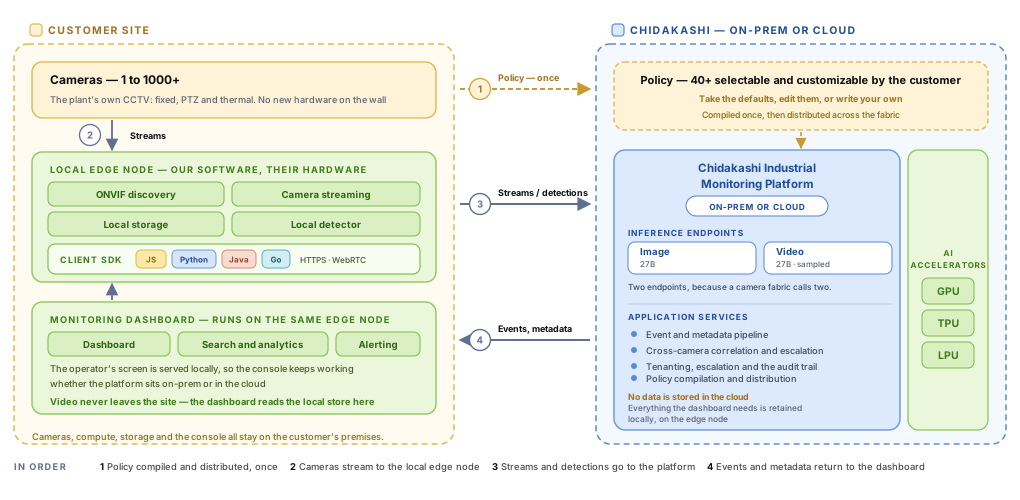
This is an application platform, not a model endpoint, and that is what separates it from the SDK deployment. The chain is camera, local edge node, monitoring platform, and back to a dashboard that runs on that same edge node.
The return leg is the point. An operator's screen is served locally, so the console keeps working whether the platform sits on-premises or in the cloud, and video never has to leave the site for a human to look at it.
The edge node does more than inference: ONVIF discovery, camera streaming, local storage and a local detector, with the client SDK sitting inside it. A site's own systems integrate against the node on their premises rather than against a cloud endpoint.
| Step | What happens |
|---|---|
| 1 | Policy compiled and distributed, once. |
| 2 | Cameras stream to the local edge node. |
| 3 | Streams and detections go to the platform. |
| 4 | Events and metadata return to the dashboard. |
A camera fabric calls two inference endpoints, image and video, so only two are drawn. Above them sit the application services the deployment actually needs: the event and metadata pipeline, cross-camera correlation and escalation, tenanting and the audit trail, and policy compilation and distribution.
No data is stored in the cloud. Everything the dashboard needs is retained locally on the edge node. Cameras, compute, storage and the console all stay on the customer's premises; the platform itself can be deployed on-premises or in the cloud, which is why its zone is labelled by ownership rather than by location.
Where industrial safety sits
Industrial safety is Video Safety deployed at facility scale: the same streamed-video verdicts, with a prebuilt catalogue, a camera fabric, and site-level configuration on top. For a robot that acts on what it sees rather than a camera that watches, see Robotics Safety.